Breaking Down the Giant: Is Uttar Pradesh Ready to Be Divided into 4 States?
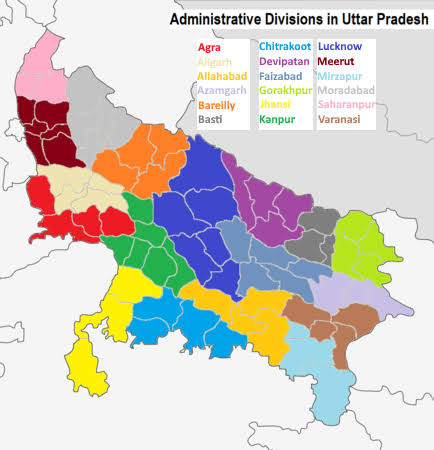
Uttar Pradesh (UP), India’s most populous state and the political epicentre of the nation, is once again at the center of a major debate. With a massive population hovering around 24 to 25 crore (240–250 million) and holding 80 Lok Sabha seats—the gateway to Delhi’s throne—discussions about splitting the state into smaller administrative units have resurfaced.
Recently, statements from within the Yogi Adityanath-led state cabinet regarding the division of UP have sparked widespread political speculation. But is this a genuine administrative restructuring plan, or is it merely political posturing? Let us examine the history, the politics, the administrative challenges, and the potential consequences.
The Blueprint: 403 Seats and Four Proposed States
Under the current proposal floated by political figures like state minister Om Prakash Rajbhar, Uttar Pradesh would be divided into four distinct states:
- Purvanchal (Eastern UP): Covering around 22 to 32 districts, including Gorakhpur and Varanasi, with a population exceeding 6 crore.
- Awadh Pradesh (Central UP): Centered around Lucknow, Ayodhya, and Kanpur.
- Pashchim Pradesh or Harit Pradesh (Western UP): Encompassing industrial hubs like Meerut, Ghaziabad, Noida, Bareilly, and Muzaffarnagar.
- Bundelkhand: Comprising backward southern districts such as Jhansi, Lalitpur, and Banda.
Historical Roots: Dr. B.R. Ambedkar’s Vision
The idea of dividing UP is not new. Its origins trace back to the architect of the Indian Constitution, Dr. B.R. Ambedkar. In his 1955 book Thoughts on Linguistic States, Ambedkar proposed dividing the then United Provinces (which had a population of 6 crore at the time) into three separate states of roughly 2 crore people each, suggesting Meerut, Kanpur, and Allahabad as respective capitals. He also advocated splitting Bihar, leading to the creation of Jharkhand in the year 2000 under Atal Bihari Vajpayee’s government, alongside the creation of Uttarakhand from UP.
Later, in November 2011, then-Chief Minister Mayawati took formal legislative steps. Her cabinet passed a resolution in the state assembly to split UP into four parts, sending the proposal to the central government just ahead of the 2012 assembly elections. However, the proposal stalled when the UPA government at the Centre did not act, and the file was permanently shelved after Akhilesh Yadav assumed office in 2012.
Constitutional Power: Can the Centre Divide UP?
From a legal standpoint, the power to alter state boundaries or create new states rests entirely with the Parliament of India under Article 3 of the Constitution.
- The Process: A bill for state reorganization requires prior recommendation from the President of India.
- State Assembly Role: The President refers the bill to the concerned state legislature for its views within a specified timeframe.
- Advisory Only: Crucially, the state assembly’s opinion is merely advisory. Even if the UP state assembly completely rejects the bill, Parliament can pass it using a simple majority (not a special majority).
Landmark Supreme Court rulings, such as Babubhai Parate v. State of Bombay, established that Parliament holds supreme and ultimate authority over state boundaries, mirroring how the bifurcation of Andhra Pradesh to create Telangana was executed in 2014 despite local political opposition. If the central government chooses to act, the constitutional mechanism is readily available.
The Economic Dilemma: Resources and Disparities
A division of Uttar Pradesh raises critical economic questions. Past bifurcations in India offer cautionary tales:
- The Bihar-Jharkhand Split (2000): Jharkhand absorbed over 40% of the combined mineral wealth, including 32% of India’s coal, 25% of its copper, and critical uranium reserves. Meanwhile, Bihar was left largely agrarian, flood-prone, and devoid of major heavy industries.
- The Andhra-Telangana Split (2014): Telangana retained Hyderabad—the economic engine—leaving Andhra Pradesh to build a new capital from scratch.
In the case of UP, Western UP and the NCR region (accounting for roughly 18 districts) generate nearly 60% of the state’s total GDP, driven by Noida, Greater Noida, and manufacturing corridors.
Conversely:
- Purvanchal faces dense populations, high poverty rates, and limited industrialization.
- Bundelkhand struggles with chronic water scarcity requiring massive, capital-intensive river-linking projects.
- Awadh contains economically vital cities like Lucknow and Kanpur, but surrounding rural districts remain impoverished.
A newly formed state with low tax revenues and heavy infrastructure deficits would face immense financial strain in managing governance independently.
Breaking Down the Giant: Is Uttar Pradesh Ready to Be Divided into 4 States?
Political Impact: Blessing or Curse for the BJP?
The political ramifications of dividing India’s largest state are complex, particularly for the ruling Bharatiya Janata Party (BJP):
- Leadership and Campaign Strategy: Currently, the BJP leverages the formidable political weight of Chief Minister Yogi Adityanath to anchor the entire state. Dividing UP would require the party to develop distinct leadership faces and separate electoral strategies across four different regions.
- The Western UP Challenge: While regions like Awadh or Bundelkhand might favor the BJP, Western UP presents a delicate demographic and political hurdle. With a higher minority population share (ranging from 26% to 40% in key districts) and complex Jat-Dalit community dynamics, a separate Western UP state could alter electoral arithmetic significantly.
- Current Stance: While regional leaders like Om Prakash Rajbhar voice aspirations rooted in local identity politics (such as a separate Purvanchal state benefiting local communities), the BJP high command and Yogi Adityanath have maintained silence on the matter. Observers view an immediate division of UP as highly unlikely in the near term.
Conclusion
Whether viewed through the lens of governance efficiency—managing 24+ million citizens from a single capital is undeniably challenging—or through the lens of political strategy, the debate over dividing Uttar Pradesh touches the core of Indian federalism.
1 thought on “Breaking Down the Giant: Is Uttar Pradesh Ready to Be Divided into 4 States?”